
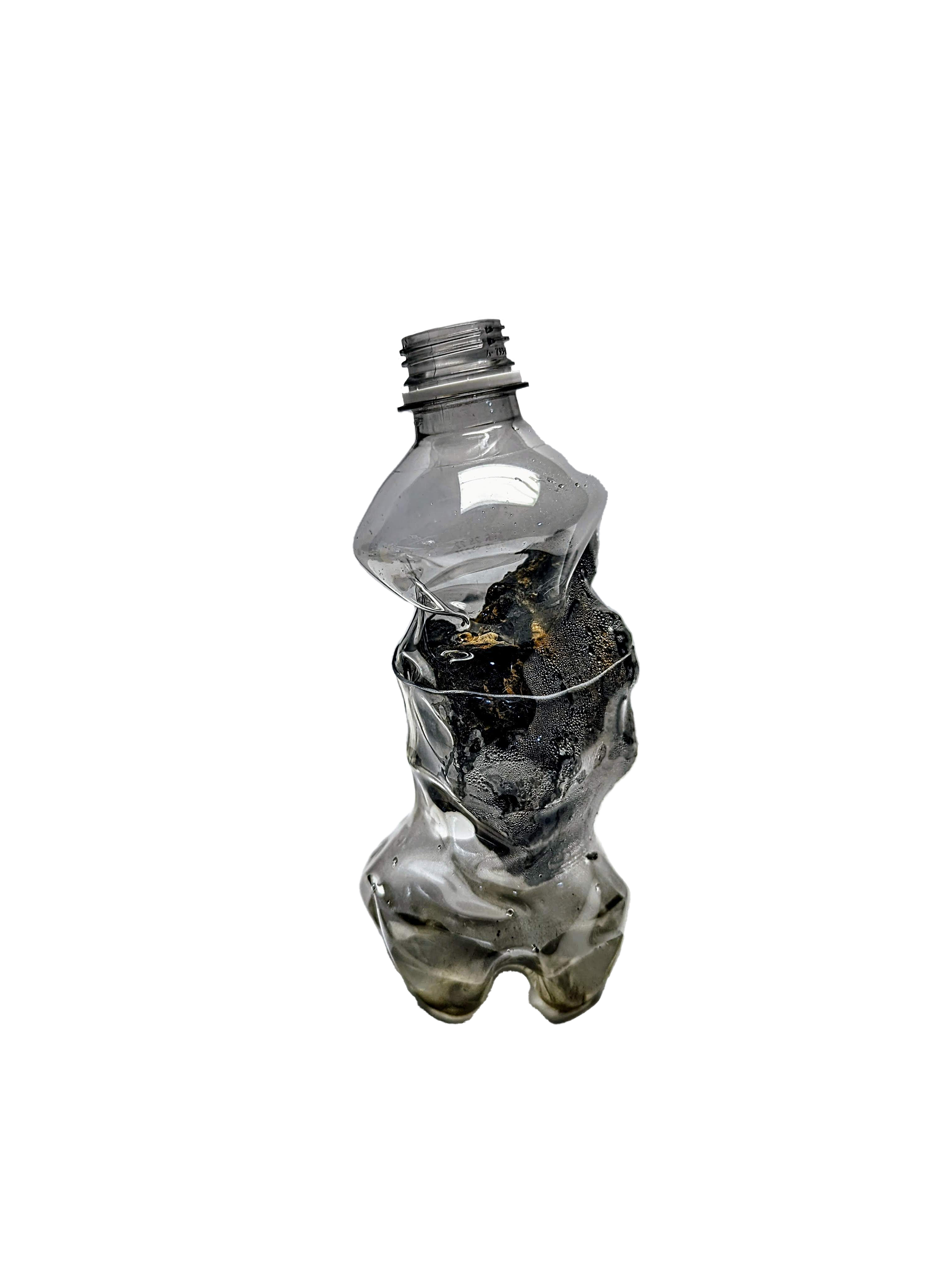
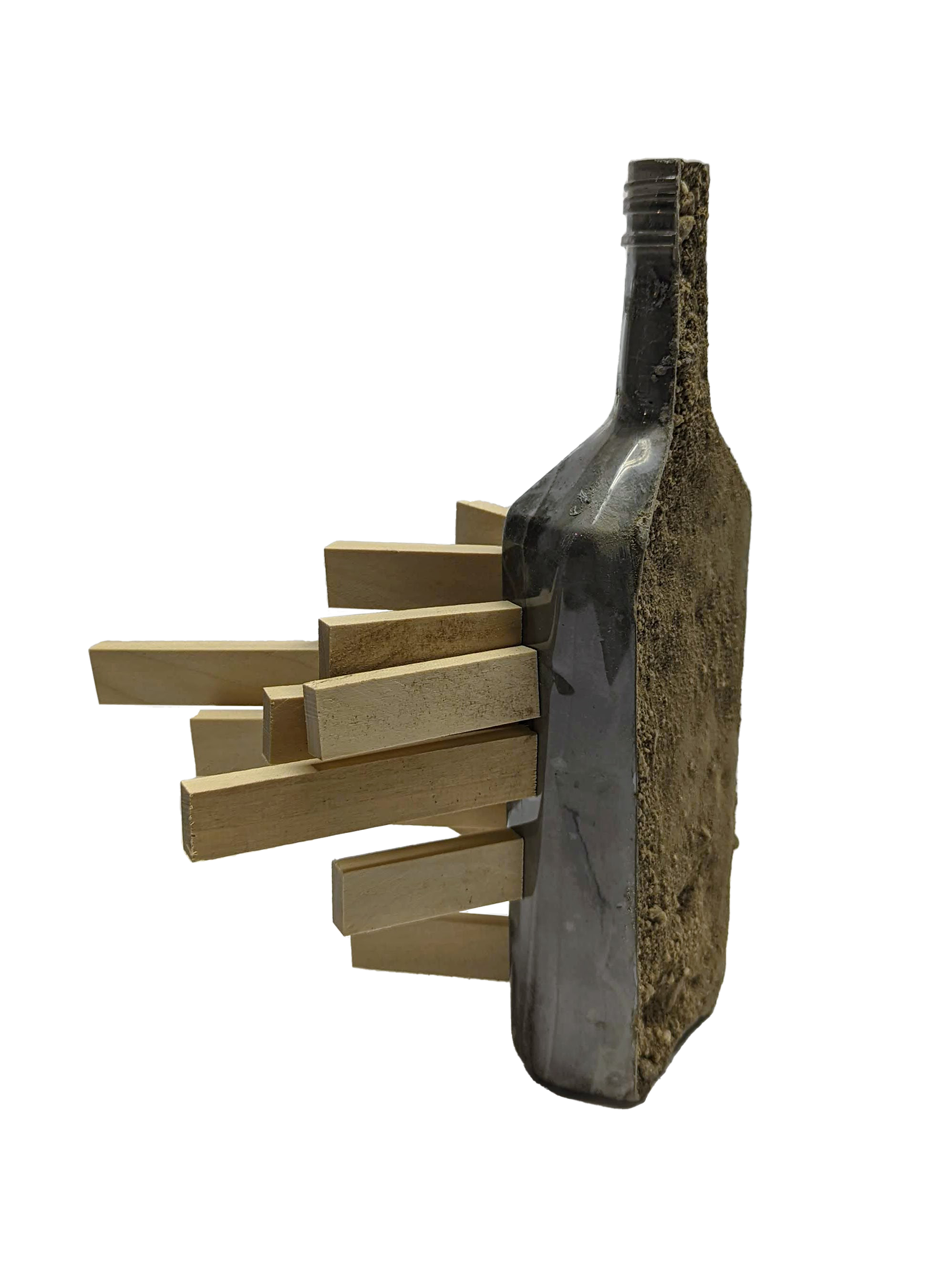
Once single-use littered plastic caught my eye, it seemed to be everywhere. Always on the lookout for interesting discarded human artifacts, I tried to look at plastic in a new light. These found-objects are a form of self portrait, designed by humans to fit human hands. As such, on a macro level, humanity is transforming the natural landscape into a grim portrait of itself through litter. The pervasiveness of litter is deleterious both mentally and ecologically.
Employing positive psychology, I wanted to change its identity from ‘waste’ to ‘resource’. Designing an independent study around litter, my aim was to create a shift from moral obligation or existential dread to a fun experience. Gamifying litter removal into collecting interesting materials, I demonstrated opportunity out of pollution. The primary barrier, lack of familiarity working with these materials, was overcome by extensive research, experimentation, and iteration. With a philosophy of affordability, minimizing waste, and preventing loss of object identity, many methods were eliminated. Three primary techniques of controlled heat emerged. ‘Spot-welding’ and ‘riveting’, using a wood burner, and ‘shrink-wrapping’ using a heat gun, are demonstrated in three final pieces.


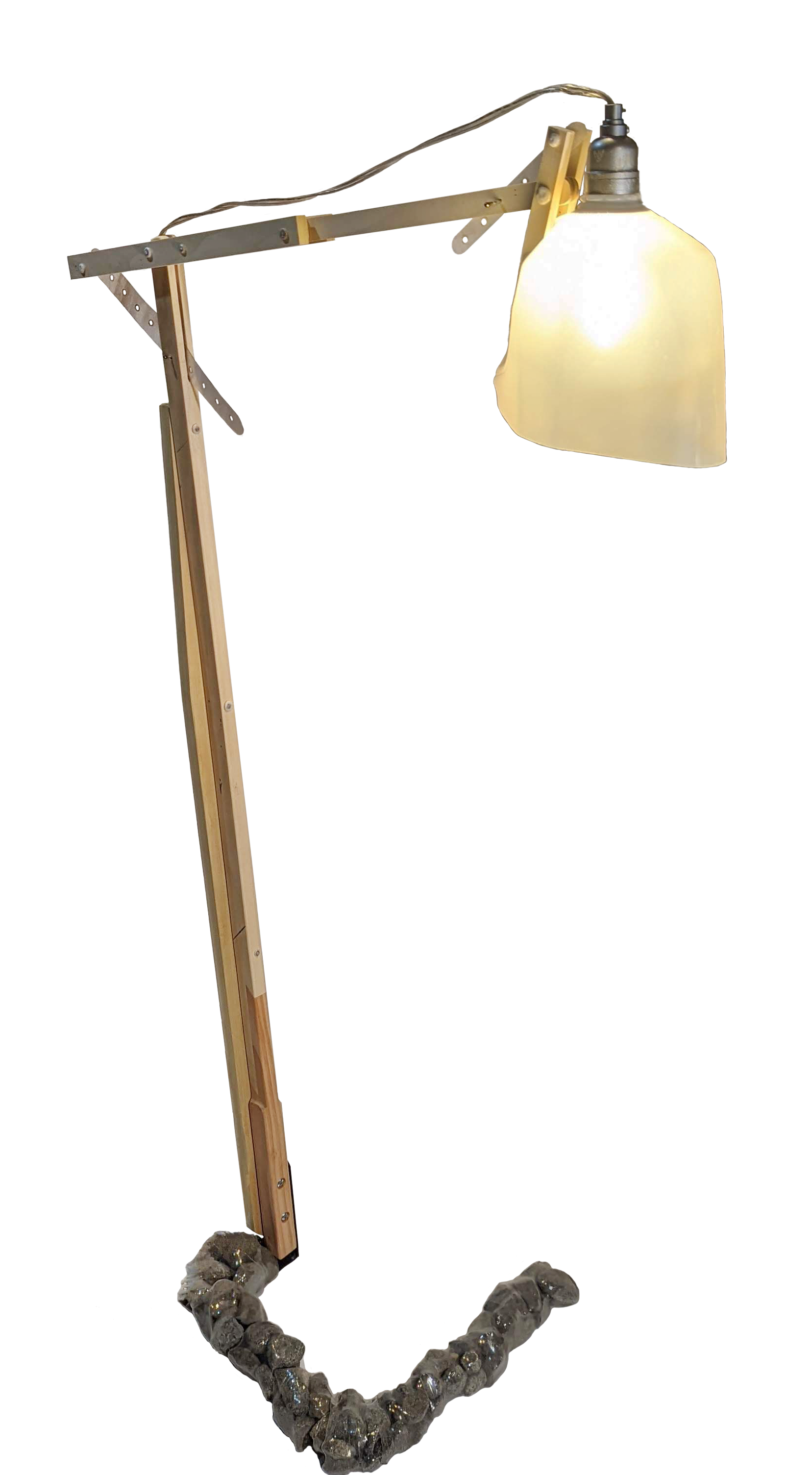
Lamp
Overlapping plastic is heat-shrunk around stones. Plastic rivets are used for working hinges and construction of the wood components. The natural shape of milk jugs lend themselves to lamp shades with minimal intervention. The goal was to maintain the identity of the material as a waste product, while suggesting that it can still be useful, and even aesthetically pleasing.
Steel base frame for stability, wrapped in stones for weight, and sealed together with plastic. Angles are adjustable via a plastic welded strip under constant tension, weighted by the opposite side of the hinge. The form of the gallon jug is accentuated, not hidden, it’s identity on full display. The handle is the logical connection point, and the mouth of the jug serendipitously mates with the light fixture.
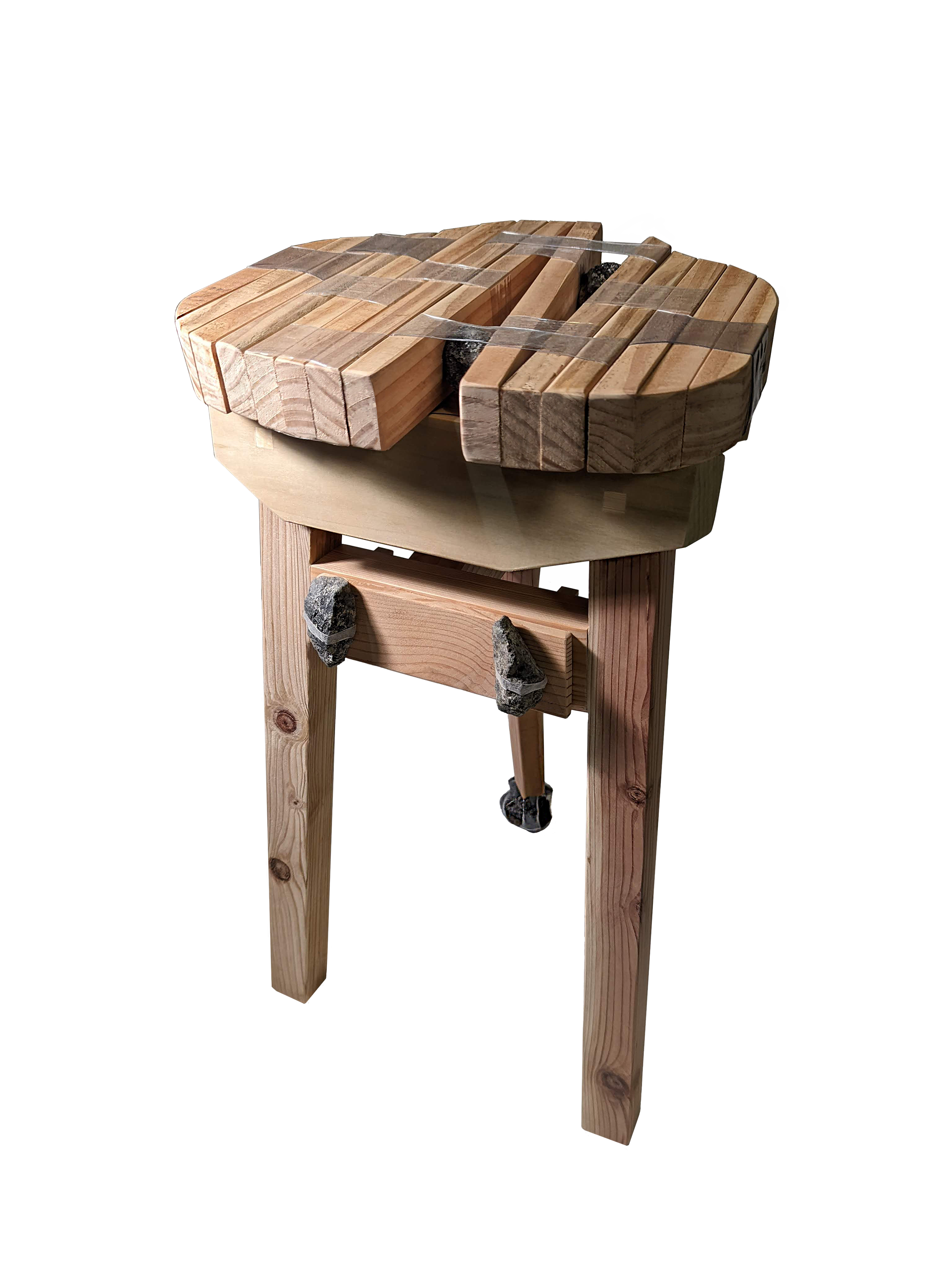
Stool
The stool showcases multiple forms of the same base technique. It is an iteration of a design using sections of wood joined by plastic, in conjunction with traditional carpentry joints. For the stone foot, plastic rings are used to stabilizing the stack, crossed over one another, attached to the wood leg, and shrunk into place around the stones, applying tension. The stone to wood connection has incredible compression strength.
The wood-to-wood connection the uses plastic rings from bottle cross sections, and is both incredibly fast and strong, even when set at angles, and holding stones sandwiched. There is also potential as a tenon alternative. The tenon here being a plastic ring passing through a hole in the wood, and the wedge being a stone fitted within the end of the ring. A quick pass with the heat gun pulls the plastic tight, and the connection is secure
Sculpture
As with all three final pieces, dozens of experiments came together for a powerful whole. A huge variety of forms can be created using the spot-welding technique. In contrast with the more utilitarian spot welding of the lamp, this piece uses widely differing shapes of plastic. The wood-to-plastic connection and suspension of stones further illustrates the potential interfacing with other materials. Stones do not require any fastener, held instead by the pressure of inflated balloons, which lend visual weight. The legs are attached with screws, through holes formed by the spot welds, with the shape of the plastic being stabilized by stone and pressure. Stones are suspended in the core, with the plastic weight being negligible. Due to the weight ratio and radial leg pattern, it is highly repositionable, even as a cantilever.

 ParSculpture